The West Bengal Assembly Elections 2026 have entered a crucial stage, with intense campaigning reaching its peak ahead of the final phase of voting. Political leaders from major parties have ramped up their efforts, making strong statements and promises to influence voters across the state. With polling for 142 constituencies scheduled on April 29, the last day of campaigning witnessed high-energy rallies, sharp political attacks, and bold claims from all sides.
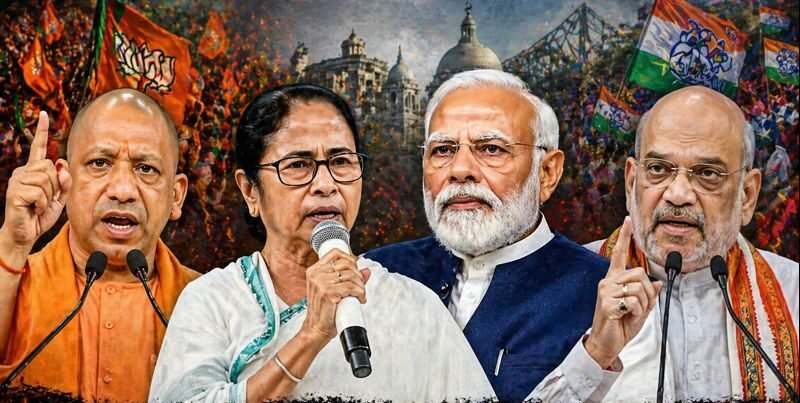
Uttar Pradesh Chief Minister Yogi Adityanath stirred controversy during his rally in Hooghly by launching a direct attack on the ruling Trinamool Congress (TMC). He alleged that issues such as “love jihad” and “land jihad” were prevalent in West Bengal and accused the Mamata Banerjee-led government of remaining silent on these matters. Drawing comparisons with Uttar Pradesh before 2017, Yogi claimed that strict governance under the BJP had brought significant improvements in law and order.
Prime Minister Narendra Modi also intensified the BJP’s campaign with a strong show of confidence. Addressing a rally in Barrackpore, he expressed optimism that the BJP would form the next government in West Bengal. Modi emphasized the concept of a “double-engine government,” suggesting that having the same party in power at both the state and central levels would accelerate development projects. He highlighted initiatives such as expanding the Kolkata Metro network, introducing electric buses, and implementing welfare schemes for women and the elderly.
Modi also made emotional appeals to voters, particularly women, promising better safety and opportunities under a BJP government. He assured that schemes like financial assistance for pregnant women and healthcare benefits for senior citizens would be introduced. Additionally, he reiterated the party’s commitment to fulfilling the vision of Syama Prasad Mookerjee and stressed that the elections would play a key role in shaping the future of eastern India.
On the other hand, Chief Minister Mamata Banerjee remained confident about her party’s prospects. She stated that the TMC would return to power, citing strong public support during her campaigns and padyatras. Banerjee emphasized her government’s focus on welfare schemes and development initiatives, arguing that the people of Bengal have consistently supported her leadership since 2011. She framed the election as a continuation of the “Maa-Mati-Manush” ideology, which she believes still resonates strongly with voters.
Union Home Minister Amit Shah added momentum to the BJP’s campaign by conducting a roadshow in Kolkata in support of party candidates. He expressed confidence that the BJP would emerge victorious and form the government in the state. Shah also highlighted the peaceful conduct of elections so far and reiterated the party’s broader agenda, including policy reforms and governance changes.
Meanwhile, BJP leader Suvendu Adhikari claimed that a “saffron wave” was sweeping across Bengal, predicting a strong voter turnout in favor of the BJP. At the same time, AAP leader Arvind Kejriwal extended his support to Mamata Banerjee, alleging irregularities such as large-scale voter list issues and accusing the system of undermining democracy.
As campaigning concludes, the political atmosphere in West Bengal remains highly charged. The outcome of this election is expected to have significant implications not only for the state but also for national politics. With major leaders making bold promises and accusations, voters now hold the key to deciding the future direction of Bengal.