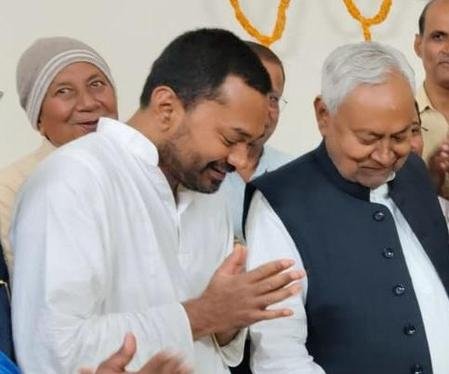
In a surprising development in Bihar politics, Nishant Kumar has declined the offer to become Deputy Chief Minister, putting an end to speculation about his immediate rise in state leadership. His decision comes at a time when political equations in Bihar are shifting, particularly with the growing dominance of the BJP in the state.
Instead of Nishant, senior leaders from the Janata Dal (United) — Vijay Kumar Chaudhary and Bijendra Prasad Yadav — were sworn in as Deputy Chief Ministers alongside BJP leader Samrat Choudhary. The move signals a recalibration of power within the alliance, with the BJP now playing a more prominent role in governance.
Sources within JD(U) reveal that party leaders had strongly encouraged Nishant to accept the post. However, he chose to step back, citing lack of experience and a desire to first understand grassroots politics. He reportedly conveyed that he would prefer to spend time interacting with party workers and the public before taking up any major responsibility.
Nishant, who recently entered active politics, appears to be following a cautious approach. Party insiders say both he and his father, Nitish Kumar, have consistently opposed dynastic politics. By refusing a high-profile post early in his career, Nishant aims to build credibility on his own rather than being seen as benefiting from family legacy.
At the same time, his decision has sparked mixed reactions within the party. While some believe it reflects maturity and long-term planning, others feel that accepting the role could have strengthened the party and preserved Nitish Kumar’s political legacy at a time when JD(U) faces internal challenges.
Political analysts suggest that the broader context is crucial. With the BJP securing its first Chief Minister in Bihar, there is a visible shift in power dynamics. Experts believe the BJP may now seek to shape governance in the state according to its own political framework, potentially reducing the influence of regional allies.
Some JD(U) leaders also fear that declining the post could weaken the party’s position, especially as it navigates internal divisions and changing alliances. However, supporters argue that Nishant’s grassroots approach may help him build a stronger foundation for the future.
As Bihar enters a new political phase, Nishant Kumar’s decision highlights the tension between legacy politics and merit-based leadership. Whether this cautious strategy will pay off remains to be seen in the evolving political landscape.