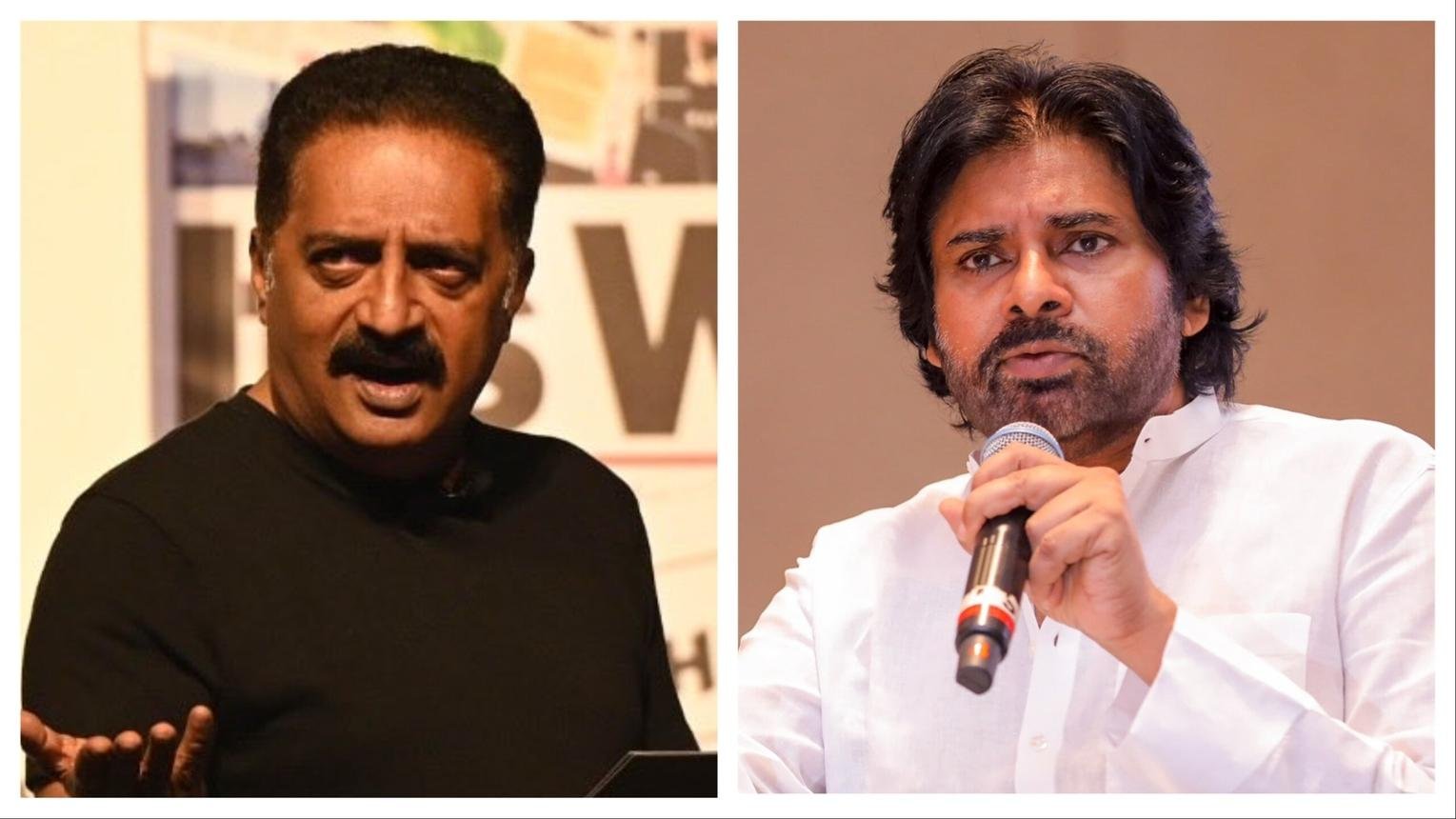
Actor and political commentator Prakash Raj has strongly criticised Andhra Pradesh Deputy Chief Minister Pawan Kalyan over his recent remarks on the Women’s Reservation Bill, sparking a heated political exchange. The controversy began after Pawan Kalyan shared his views on social media, blaming opposition parties for allegedly obstructing the progress of the bill aimed at increasing women’s representation in legislative bodies.
In his post, Pawan Kalyan described the Women’s Reservation Bill as a crucial reform that could enhance gender equality and strengthen democracy. He claimed that opposition parties had deliberately blocked its progress in Parliament, suggesting that political interests were being placed above national development. According to him, such resistance reflects a lack of commitment toward empowering women and ensuring inclusive governance in the country.
However, Prakash Raj quickly responded, challenging both the accuracy and intent of these claims. He accused Pawan Kalyan of spreading misleading information and aligning his narrative with that of the central leadership, particularly in support of Narendra Modi. Prakash Raj argued that the Women’s Reservation Bill had already received approval earlier and could still be implemented if there was genuine political will.
Taking his criticism further, Prakash Raj linked the delay in implementation to the broader issue of delimitation. He claimed that prioritising delimitation before enforcing women’s reservation could negatively impact representation for southern states, including Andhra Pradesh. According to him, such moves might weaken the political voice of these regions, raising concerns about fairness and balance in the democratic process.
In a direct and bold move, Prakash Raj challenged Pawan Kalyan to a public debate, stating that he was ready to explain his stance in detail. He urged the Deputy Chief Minister to engage in an open discussion on the issue rather than making statements on social media. His comments reflected a larger concern about political accountability and the responsibility of leaders to provide accurate information to citizens.
This exchange is part of Prakash Raj’s ongoing pattern of outspoken political commentary, particularly on the growing trend of film actors entering politics. Recently, he also made remarks that were widely interpreted as a critique of actor-turned-politician Vijay, who is preparing for his political debut in Tamil Nadu.
Speaking at a campaign event, Prakash Raj outlined what he described as three distinct political approaches: the Dravidian model, the “slave model,” and the “cinema model.” Without directly naming Vijay, he questioned whether popularity in films should automatically translate into political leadership. He emphasized that acting and governance require entirely different skill sets and levels of responsibility.
Prakash Raj pointed out that while fans may celebrate actors for their on-screen performances, governance demands real-world experience, consistent public engagement, and a deep understanding of societal issues. He argued that political leaders must earn public trust through sustained work on the ground rather than relying solely on celebrity status.
To illustrate his point, he highlighted leaders who have spent years working with communities and addressing public concerns. He suggested that entering politics without such groundwork risks undermining the seriousness of governance. According to him, voters must carefully consider whether they are choosing leaders based on merit and commitment or simply on popularity.
Interestingly, Prakash Raj shares a professional history with both Pawan Kalyan and Vijay, having worked alongside them in several films. Despite these associations, he has not hesitated to express his views when it comes to political matters, reinforcing his image as a vocal and independent commentator.
The ongoing debate between Prakash Raj and Pawan Kalyan reflects broader discussions within Indian politics about transparency, regional representation, and the role of public figures in shaping political narratives. It also highlights the increasing intersection of cinema and politics, especially in southern states where film stars often command massive public influence.
As discussions around the Women’s Reservation Bill and delimitation continue, such exchanges are likely to fuel further debate among political leaders and the public alike. Whether this challenge leads to a direct debate between the two figures remains to be seen, but it has certainly drawn attention to key issues surrounding governance, representation, and accountability in India’s evolving political landscape.