
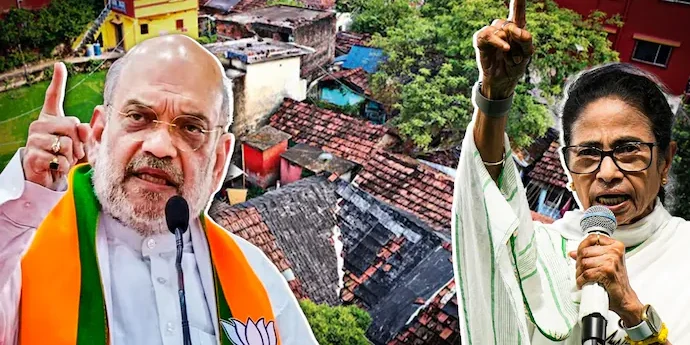
A recent political remark by Union Home Minister Amit Shah describing Kolkata as a “city of slums” has sparked intense debate across political and public circles. The statement, made during an election rally in West Bengal, triggered strong reactions, especially from leaders of the Trinamool Congress, who called it an insult to the city’s legacy. But how accurate is this claim? Let’s look at the facts.
Kolkata, the capital of West Bengal, is historically known as the “City of Joy.” It is one of India’s oldest metropolitan cities with rich cultural, intellectual, and architectural heritage. However, like most major urban centers in India, it also has a significant number of slum settlements. The key question is whether Kolkata can truly be labeled as a “slum city,” or if the reality is more nuanced.
According to data from the Census of India (2011), Kolkata had around 2,000 registered and approximately 3,500 unregistered slums. About 1.49 million people lived in these settlements, spread across more than 300,000 households. Given that the city’s total population at the time was slightly over 4 million, this means nearly one-third or roughly 33%of Kolkata’s residents were living in slum areas.
At first glance, this figure may appear high. However, a broader comparison with other major Indian cities tells a different story. For example, Mumbai, the country’s financial capital, has an even higher proportion of its population living in slums. Data shows that nearly 42% of Mumbai’s residents live in informal settlements, including the well-known Dharavi, one of the largest slums in the world.
Similarly, Chennai has about 28% of its population living in slum areas, while Delhi reports around 15%. Compared to these cities, Kolkata’s 33% places it somewhere in the middle not the highest, but certainly not negligible either.
It is important to understand that slum populations are a common feature of rapidly urbanizing cities, especially in developing countries. Migration from rural areas in search of employment often leads to the growth of informal settlements. Therefore, Kolkata’s situation is not unique it reflects a broader urban challenge faced across India.
Another aspect to consider is that the data being referenced comes from the 2011 Census, which is currently the most comprehensive dataset available. While conditions may have changed over the years, there is no official updated nationwide data to conclusively show whether the percentage has significantly increased or decreased by 2026.
Experts also point out that labeling an entire city based on one aspect can be misleading. Kolkata continues to be a major hub for education, culture, healthcare, and commerce. It has modern infrastructure, historic landmarks, and a vibrant urban life that goes far beyond its slum areas.
while Kolkata does have a sizable slum population, calling it a “city of slums” is an oversimplification. Data shows that several other Indian cities face similar or even greater challenges. The reality is more complex Kolkata is both a city of heritage and a city dealing with urban inequalities, much like many metros across the country.