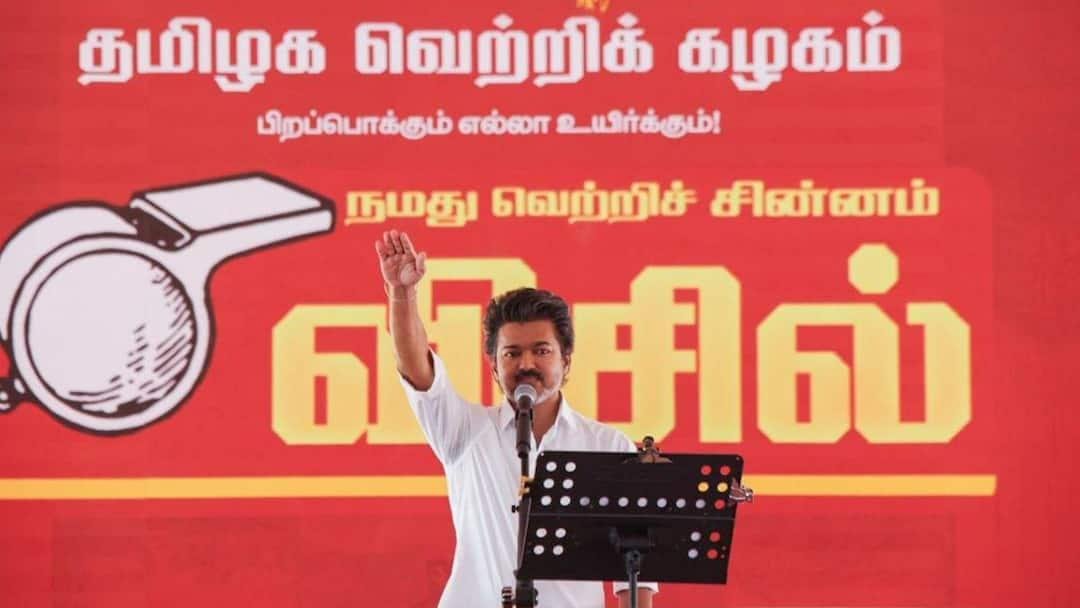
Tamil Nadu has a long-standing tradition of blending cinema and politics, where film stars often rise to powerful political positions. Legendary personalities like M. G. Ramachandran and J. Jayalalithaa successfully transitioned from silver screen icons to influential leaders. Similarly, writers like C. N. Annadurai and M. Karunanidhi also shaped the political landscape. Now, actor Vijay is attempting to follow in their footsteps.
With the Tamil Nadu Assembly election results approaching, Vijay’s political ambitions are under intense scrutiny. While many exit polls suggest a likely win for the ruling Dravida Munnetra Kazhagam, some predictions—like those from Axis My India—hint that Vijay’s party could perform strongly, even drawing comparisons with MGR’s historic rise. However, exit polls are not always reliable, leaving room for surprises.
Vijay’s political journey has been gradual rather than sudden. As early as 2009, his fan base—estimated at around 85,000 clubs—was organised into a welfare group called Vijay Makkal Iyakkam (VMI). Initially focused on social service, the organisation slowly began engaging in political activities. This approach mirrors that of MGR, who once transformed his fan clubs into a strong political machinery.
Born into a film family, Vijay began his acting career as a child artist and later debuted as a lead actor in 1992. Though his first film did not succeed, he steadily built a massive fan following. Over time, his movies began reflecting social and political themes. Films like Kaththi, Mersal, Bigil, and Sarkar portrayed him as a champion of public issues such as farmers’ struggles, healthcare corruption, women’s empowerment, and electoral integrity. These roles helped shape his public image as a socially conscious leader.
Despite his growing influence, Vijay’s political path has not been without challenges. The experiences of actors like Sivaji Ganesan, Kamal Haasan, Vijayakanth, and Khushbu Sundar serve as reminders that cinematic popularity does not always translate into electoral success. At the same time, figures like N. T. Rama Rao show that a successful transition is possible with the right timing and strategy.
Vijay’s political intentions became clearer over the years through public statements and social interventions. His support for fishermen’s issues and his reaction to the anti-NEET protests demonstrated his willingness to engage with real-world concerns. More recently, his party has focused on key voter groups such as youth, women, and fishermen. Promises include financial aid, education loans, welfare schemes, and subsidies aimed at improving livelihoods.
However, his leadership has also faced criticism. A tragic stampede during a political rally raised concerns about organisational preparedness and crisis management. Additionally, personal controversies have added to the challenges surrounding his political image.
Despite these hurdles, Vijay enjoys strong support among younger voters, many of whom are seeking alternatives to established parties like the DMK and AIADMK. His party has clearly stated that it will not align with either the BJP or DMK, positioning itself as an independent force.
Entering politics at the peak of his film career, Vijay represents a new generation of actor-politicians. With his party symbolised by a whistle and a call for change, the upcoming election results will determine whether he can transform his cinematic charisma into lasting political success.