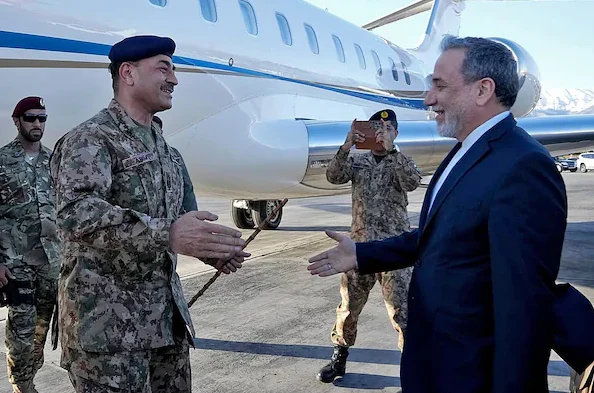
Pakistani military personnel welcoming Iranian officials during a visit at Nur Khan Airbase amid US-Iran tensions.
Fresh reports have sparked international debate after claims emerged that Pakistan secretly allowed Iranian military aircraft to use the strategically important Nur Khan Airbase near Islamabad during rising tensions between Iran and the United States. The move, if confirmed, could raise serious questions about Pakistan’s neutrality while it publicly positioned itself as a diplomatic mediator between Tehran and Washington.
According to reports quoting American sources, Iran allegedly shifted several important military and aviation assets to Pakistan shortly after conflict intensified in the Middle East. Among the aircraft reportedly moved was an Iranian Air Force RC-130 reconnaissance aircraft, a military intelligence and surveillance plane based on the Lockheed C-130 Hercules platform. The aircraft was reportedly parked at Nur Khan Airbase, located close to Rawalpindi and Islamabad, where it could remain protected from possible American or Israeli airstrikes.
Sources also claimed that some Iranian civilian aircraft were temporarily relocated to neighbouring Afghanistan after Iranian airspace became unsafe during the conflict. However, there has been no confirmation that military aircraft were moved into Afghanistan.
The report suggested that Iran’s decision to move aircraft outside its borders was part of a broader strategy to safeguard valuable military and aviation assets while tensions with the United States continued. Interestingly, this allegedly happened while Pakistan was publicly involved in diplomatic efforts aimed at reducing tensions and promoting ceasefire talks between both countries.
The claims have triggered political reactions in Washington. Senior Republican senator Lindsey Graham questioned Pakistan’s credibility as a neutral mediator if the allegations prove true. In a public statement, Graham said such reports would require a complete reassessment of Pakistan’s role in diplomatic negotiations involving Iran and the United States.
Pakistan, however, strongly denied the allegations. Officials reportedly dismissed the claims as unrealistic, arguing that Nur Khan Airbase is located in a highly populated urban area where unusual military activity could not remain hidden from the public. Pakistani authorities insisted no secret Iranian aircraft operations took place at the airbase.
Afghanistan also responded to the controversy. Aviation officials in Kabul confirmed that one Iranian civilian aircraft belonging to Mahan Air had briefly remained parked at Kabul airport after Iranian airspace restrictions were imposed during the conflict. The aircraft was later shifted to Herat airport near the Iranian border for safety reasons. However, Taliban spokesperson Zabihullah Mujahid denied reports suggesting Iranian military aircraft were stationed in Afghanistan.
The controversy has once again placed Pakistan under international scrutiny over its balancing act between global powers. Islamabad has been trying to maintain relations with Washington, Tehran, and China simultaneously while also positioning itself as a regional peace broker.
Security analysts believe the situation highlights the complicated geopolitical environment in South Asia and the Middle East. Pakistan’s growing military cooperation with China, its strategic ties with Iran, and its diplomatic relationship with the United States make its position increasingly delicate during regional conflicts.
At the same time, tensions between the United States and Iran continue to remain high despite ceasefire discussions. Reports indicate that Tehran recently proposed conditions for ending the conflict, including removal of sanctions and recognition of Iranian control over the Strait of Hormuz. However, Washington reportedly rejected those demands.
As global attention remains focused on the Middle East crisis, the allegations involving Pakistan and Iranian military aircraft are likely to fuel further diplomatic debate in the coming days.