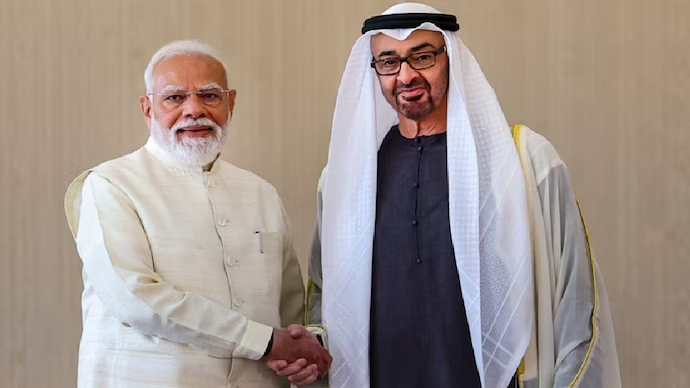
India and the United Arab Emirates have taken a major step toward strengthening their long-term energy partnership, with the UAE agreeing to store up to 30 million barrels of crude oil in India’s Strategic Petroleum Reserve. The announcement came after high-level talks between Prime Minister Narendra Modi and UAE President Sheikh Mohamed bin Zayed Al Nahyan during Modi’s visit to Abu Dhabi.
According to the Ministry of External Affairs (MEA), the agreement is expected to significantly improve India’s energy security at a time when global oil markets are facing uncertainty due to ongoing geopolitical tensions in West Asia. The two countries discussed several areas of cooperation including crude oil supply, LNG, LPG, strategic reserves, defence ties and infrastructure investment.
The major development during the visit was the signing of a Strategic Collaboration Agreement between Indian Strategic Petroleum Reserves Limited and Abu Dhabi National Oil Company, commonly known as ADNOC. Under this agreement, the UAE’s participation in India’s strategic petroleum reserves will be expanded to 30 million barrels.
Strategic petroleum reserves are emergency stockpiles of crude oil maintained by governments to ensure uninterrupted supply during international crises, wars or disruptions in global shipping routes. For India, which imports a large portion of its crude oil requirements, expanding these reserves is considered crucial for long-term energy stability.
The leaders also discussed the importance of maintaining secure and uninterrupted navigation through the Strait of Hormuz, one of the world’s most critical oil shipping routes. The issue has gained importance due to increasing regional tensions in West Asia, which have raised concerns about possible disruptions to energy supplies and maritime trade.
India and the UAE emphasized the need for regional stability and safe trade routes to protect global energy markets and international commerce. Prime Minister Modi also reportedly reaffirmed India’s support and solidarity with the UAE amid recent regional security challenges.
In addition to crude oil cooperation, both countries agreed to explore the establishment of strategic gas reserves in India. They also welcomed a separate long-term agreement between Indian Oil Corporation and ADNOC for the supply of LPG, which is widely used in Indian households and industries.
The visit also produced significant economic outcomes beyond the energy sector. The UAE announced investment plans worth nearly USD 5 billion in India across areas such as banking, infrastructure and finance. Several new agreements were also signed in sectors including maritime cooperation, shipbuilding, defence technology and advanced computing.
Officials from both countries described the UAE as one of India’s most reliable energy partners. The MEA said the two nations are now looking at a broader and more comprehensive energy partnership that covers not only oil supplies but also clean energy cooperation, logistics and long-term economic collaboration.
Experts believe the strengthened India-UAE partnership could play a key role in protecting India from future global energy shocks while also boosting economic ties between the two rapidly growing economies. The latest agreements reflect the deepening strategic relationship between India and the UAE, especially in sectors critical to economic growth and national security.