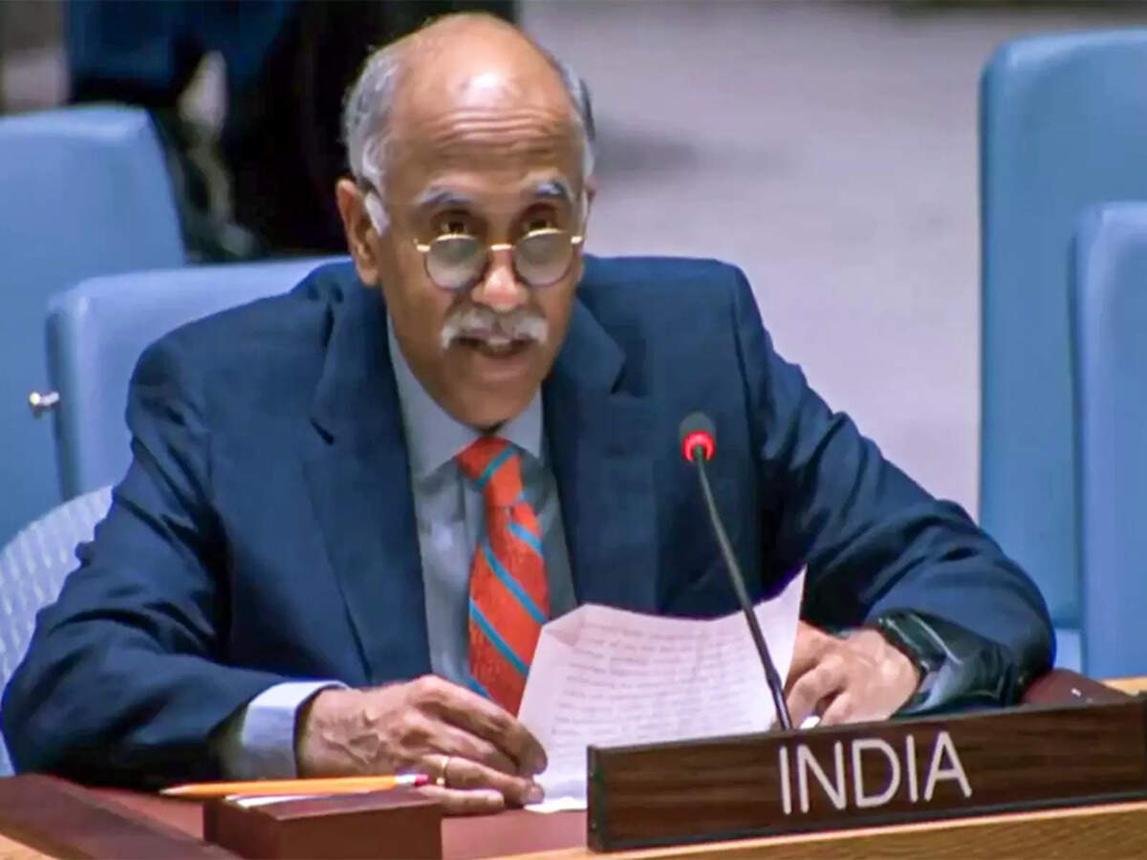
India strongly criticized Pakistan at the United Nations Security Council (UNSC), accusing its neighbor of a long history of violence, terrorism, and attacks on civilians. During the UNSC Open Debate on the “Protection of Civilians in Armed Conflict,” India’s Permanent Representative to the United Nations, Ambassador Harish Parvathaneni, delivered a sharp response after Pakistan raised issues related to Jammu and Kashmir during the session.
The Indian envoy described Pakistan’s remarks as ironic, arguing that a country with a history of violence and civilian casualties should not lecture others on humanitarian issues. He stated that Pakistan has repeatedly attempted to divert attention from its own record by raising matters that India considers internal affairs.
A major focus of India’s criticism was Pakistan’s alleged military actions in Afghanistan. Ambassador Parvathaneni referred to reports of cross-border violence and airstrikes that reportedly caused civilian casualties. He highlighted concerns raised by international observers regarding incidents that affected non-combatants, including attacks on civilian infrastructure and medical facilities.
According to the Indian representative, Pakistan’s actions have led to significant displacement and suffering among Afghan civilians. He argued that the international community has not forgotten these incidents and emphasized that the protection of civilians must remain a core principle of international law. India accused Pakistan of failing to uphold these responsibilities while simultaneously speaking about humanitarian values on global platforms.
The Indian envoy also criticized what he described as Pakistan’s double standards on international law and human rights. He stated that Islamabad often speaks about civilian protection while facing accusations related to violence beyond its borders. India argued that genuine commitment to humanitarian principles requires consistent action rather than selective criticism.
Another key part of the speech focused on historical events linked to the 1971 Bangladesh Liberation War. Ambassador Parvathaneni referred to Operation Searchlight, the military campaign conducted in what was then East Pakistan. He accused Pakistan’s military leadership of carrying out widespread atrocities during that period, including violence against civilians and large-scale human rights abuses.
India said that these historical events continue to shape global perceptions of Pakistan’s record on human rights and civilian protection. The Indian diplomat argued that such incidents cannot be ignored when discussing international humanitarian responsibilities.
The remarks also touched upon the broader issue of terrorism and regional security. India reiterated its long-standing position that terrorism remains a major threat to peace and stability in South Asia. The envoy accused Pakistan of using terrorism as a tool to advance political objectives and destabilize neighboring regions.
Concluding his address, Ambassado
r Parvathaneni stated that the global community can clearly see through what he described as Pakistan’s attempts to deflect criticism. He asserted that countries must be judged by their actions rather than rhetoric and called for greater accountability in matters involving civilian protection and international peace.
The exchange once again highlighted the continuing diplomatic tensions between India and Pakistan on international platforms. With both nations frequently raising concerns about each other at global forums, the UNSC debate became another stage for the long-running political and diplomatic rivalry between the two neighbors.