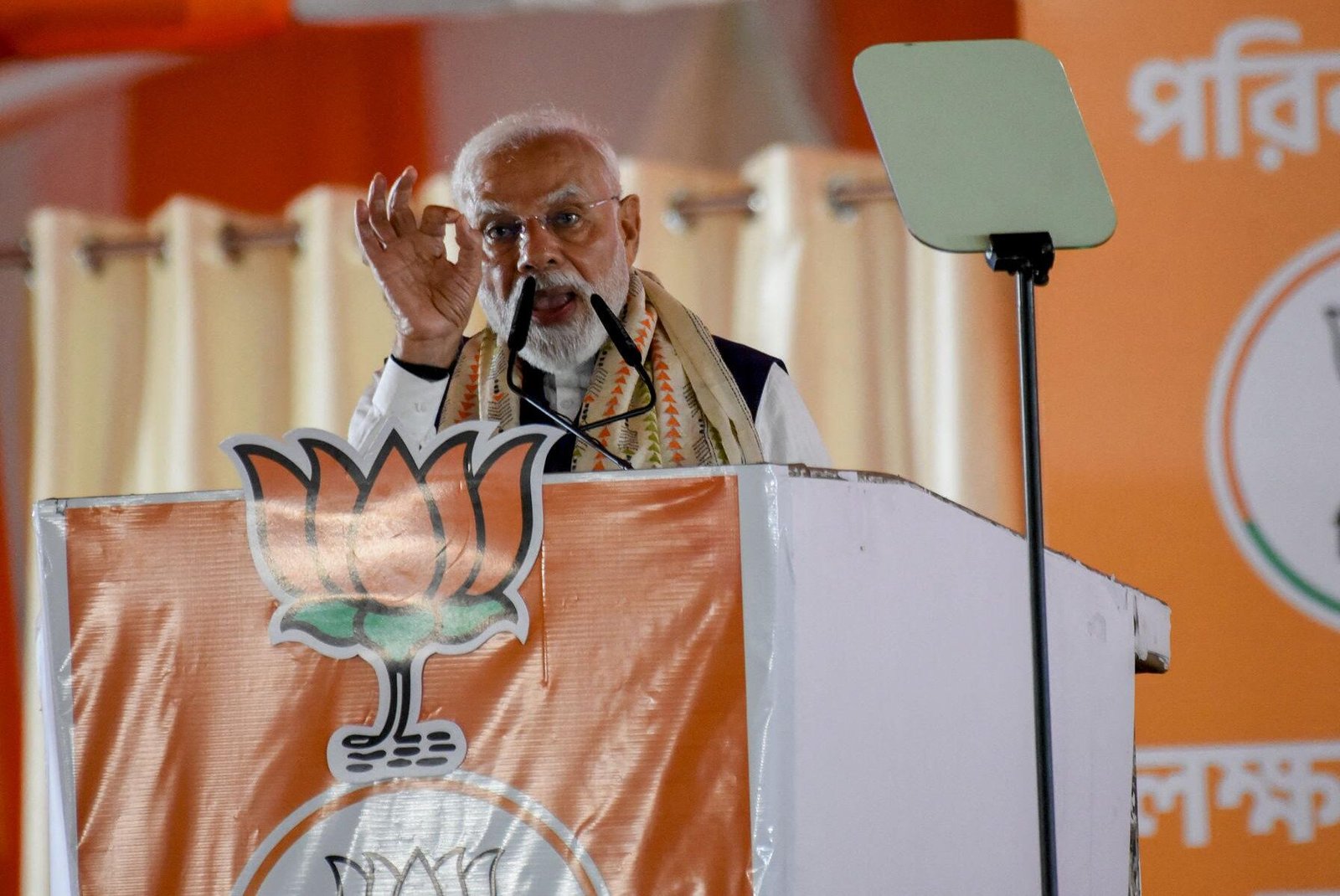
Prime Minister Narendra Modi recently addressed large public gatherings in the districts of Bishnupur and Purulia in West Bengal, where he strongly emphasized the importance of increasing women’s participation in politics for the nation’s progress. Speaking as a senior leader of the Bharatiya Janata Party (BJP), he encouraged women across the country to step forward and actively engage in governance and leadership roles.
During his speech, Modi highlighted that the development of any nation is closely tied to the empowerment of women. He stated that when women take part in decision-making processes, it leads to more balanced and inclusive growth. According to him, the BJP has consistently worked toward ensuring women’s safety, dignity, and equal opportunities, presenting the party as a strong advocate for women’s empowerment.
At the same time, the Prime Minister launched sharp criticism against opposition parties, particularly the Trinamool Congress (TMC) and the Indian National Congress. He alleged that these parties had attempted to block legislative efforts aimed at providing reservations for women in Parliament, which he claimed would delay meaningful representation until 2029. Modi suggested that such actions reveal a lack of genuine commitment to empowering women and warned that the public would hold these parties accountable.
In addition to women’s issues, Modi also raised concerns about tribal welfare. He accused both TMC and Congress of being indifferent or even hostile toward tribal communities. As part of his argument, he referenced the presidential elections, noting that these parties had fielded a candidate against Droupadi Murmu, who belongs to a tribal background. According to Modi, this demonstrated their disregard for tribal representation at the highest levels of government.
The Prime Minister further criticized the TMC government in West Bengal, accusing it of governance failures. He alleged that corruption and lawlessness under the current administration have created an atmosphere of fear among citizens. Using strong language, he described the state’s condition as “jungleraj,” implying a breakdown of order and justice. Modi also accused the state government of bending rules to benefit illegal infiltrators and introducing policies based on religious considerations, which he claimed undermines fairness and equality.
Addressing another rally in Purulia, Modi reiterated that people in West Bengal are increasingly losing trust in the ruling party and are turning toward the BJP with hope for change. He pointed out that the central government has taken several initiatives for tribal development, including the creation of a dedicated ministry for tribal affairs and increased allocation of funds. In contrast, he argued that tribal-dominated regions in West Bengal have not seen adequate progress in terms of infrastructure and basic services under the current state government.
Modi’s speeches combined a call for greater inclusion of women in politics with a broader political message criticizing opposition parties on issues of governance, corruption, and social justice. His remarks were aimed at strengthening support for the BJP while positioning it as a party committed to development, inclusivity, and empowerment across different sections of society.