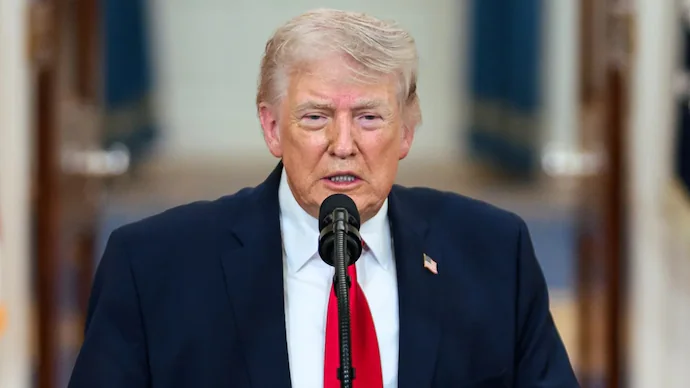
U.S. President Donald Trump has made it clear that the United States will not use nuclear weapons in its ongoing confrontation with Iran, emphasizing that conventional military actions have already inflicted significant damage. Speaking to reporters at the White House, Trump stated that there is no justification for deploying nuclear arms in the current situation and reaffirmed his stance that such weapons should never be used by any nation.
Addressing growing concerns about escalation, Trump remarked, “Why would I use a nuclear weapon? We’ve already done tremendous damage using conventional means.” He stressed that nuclear weapons represent an extreme option that should remain off the table, especially when other military strategies have proven effective. His comments appear aimed at calming fears of a broader and more dangerous conflict in the region.
At the same time, Trump issued a strong warning to Tehran, indicating that the window for reaching a diplomatic agreement is rapidly closing. “The clock is ticking,” he said, urging Iranian leadership to consider negotiations seriously. Despite the urgency in his tone, Trump clarified that he is not in a rush to finalize any deal. Instead, he emphasized the importance of securing a long-term agreement that aligns with U.S. interests and ensures regional stability.
On the military front, the United States has significantly increased its presence in the region. The deployment of the USS George H. W. Bush to the Indian Ocean marks the arrival of a third American aircraft carrier in nearby waters. It joins the USS Abraham Lincoln in the Arabian Sea and the USS Gerald R. Ford in the Red Sea. This buildup underscores Washington’s commitment to maintaining pressure on Iran while keeping military options open if necessary.
Trump claimed that Iran’s military capabilities have already been severely weakened. According to him, the country’s naval forces have suffered heavy losses, its air force has been largely neutralized, and its air defense systems have been significantly damaged. He also suggested that key leadership figures within Iran’s military structure are no longer operational, further weakening the country’s ability to respond effectively.
Although a brief ceasefire had provided Iran with some opportunity to regroup, Trump expressed confidence that any attempts to rebuild military strength could be quickly undone. He described the current blockade and strategic positioning of U.S. forces as “strong and airtight,” signaling that Iran remains under intense pressure.
In addition to military developments, Trump also addressed speculation about his willingness to end the conflict quickly. In a post on Truth Social, he dismissed claims that he is eager for a rapid resolution, criticizing sections of the media for misrepresenting his position. He reiterated that any agreement would only be accepted if it serves the interests of the United States, its allies, and global security.
Trump’s statements reflect a dual strategy—maintaining military dominance while keeping the door open for diplomacy. By ruling out nuclear weapons, he has attempted to set clear boundaries for the conflict, even as tensions remain high. However, his repeated warning that “time is running out” suggests that the situation could escalate further if negotiations fail.
As the geopolitical landscape continues to evolve, the world watches closely to see whether diplomatic efforts will succeed or whether the standoff between the U.S. and Iran will deepen in the coming weeks.