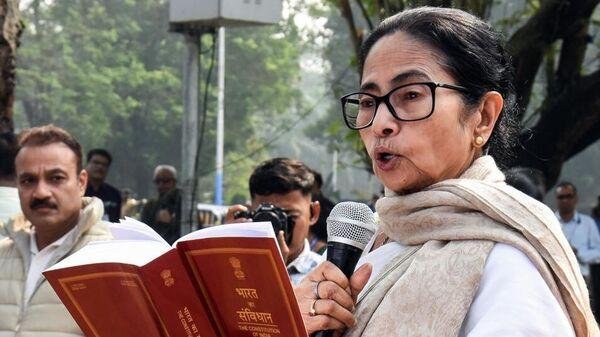
Mamata Banerjee discusses the political situation in Bengal following the dissolution of the assembly.
A major political controversy has erupted in West Bengal after Chief Minister Mamata Banerjee refused to resign following the dissolution of the state assembly. The development has triggered intense debate across the country, with constitutional experts discussing what powers a Chief Minister actually holds once an assembly is dissolved.
The situation became more dramatic after West Bengal Governor R.N. Ravi officially dissolved the state legislative assembly under Article 174(2)(b) of the Indian Constitution. According to the Governor’s notification, the dissolution came into effect from May 7, 2026. Despite this, Mamata Banerjee has reportedly decided not to step down, alleging irregularities and malpractice in the recently concluded assembly elections.
Her stand has sparked widespread political reactions. While opposition parties argue that she should immediately resign and accept the constitutional process, the Trinamool Congress leadership maintains that the election results were unfair and deserve legal scrutiny. Political analysts believe the issue could soon turn into a major constitutional and legal battle.
According to constitutional experts, once a legislative assembly is dissolved, its term officially comes to an end. At the same time, the constitutional status of the council of ministers also ceases to exist. This means the Chief Minister and cabinet can no longer function as a regular elected government with full powers.
However, there is an important constitutional convention followed in India. In many such situations, the Governor may request the outgoing Chief Minister to continue temporarily as a “caretaker Chief Minister” until a new government is formed or fresh elections are conducted. Experts point out that this arrangement is based more on democratic convention than on explicit constitutional wording.
Legal scholars say that even if Mamata Banerjee does not formally resign, she cannot continue functioning as a full-fledged Chief Minister after the assembly has been dissolved. Instead, her role would be limited to handling day-to-day administrative responsibilities without taking major policy decisions or introducing significant governance changes.
Another key issue being discussed is the legal challenge to the election results. Experts say that if any political party believes electoral malpractice took place, the proper route is through the courts. Under the Representation of the People Act, 1951, election petitions can be filed before the High Court challenging the validity of election results in specific constituencies.
Reports suggest that Mamata Banerjee and her party are preparing to approach higher courts over the election outcome. There is also speculation that the matter could eventually reach the Supreme Court if legal disputes intensify in the coming days.
The political atmosphere in West Bengal remains highly tense. Supporters of Mamata Banerjee argue that she is fighting to protect democracy, while critics accuse her of creating unnecessary constitutional uncertainty. Meanwhile, the Governor’s decision and the ongoing legal debate have pushed the state into the national spotlight.
Political observers believe the coming days will be crucial for West Bengal politics. Questions remain over whether a new government will be formed soon, whether fresh elections may become necessary, and how the judiciary will respond to the allegations raised by the ruling party.For now, the constitutional and political uncertainty surrounding West Bengal continues to dominate headlines across the country.