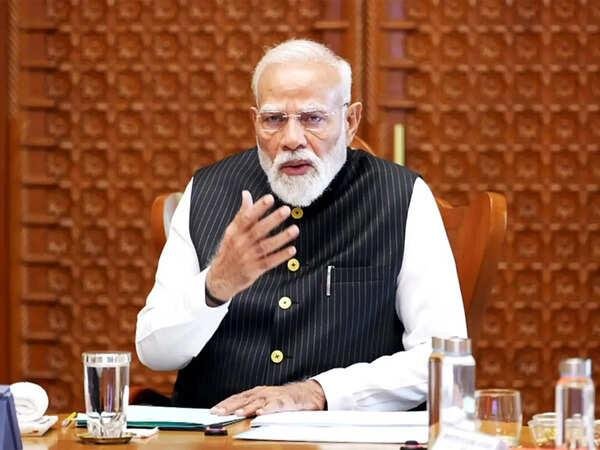
Prime Minister Narendra Modi is set to chair a significant meeting of the Council of Ministers in New Delhi on Thursday, a gathering that has attracted considerable attention due to both international developments and domestic political speculation. The meeting is scheduled to take place at Seva Teerth at 4 PM and is expected to bring together all Union Cabinet ministers, Ministers of State with Independent Charge, and Ministers of State.
Ahead of the meeting, all Union ministers have reportedly been instructed to remain in the national capital. The directive has fueled discussions about the importance of the meeting and the key issues likely to dominate the agenda.
One of the major topics expected to be discussed is the ongoing conflict in West Asia and its potential impact on India. The government has been closely monitoring developments in the region, particularly concerns related to rising crude oil prices, energy security, fuel supply chains, and inflationary pressures. As tensions continue to escalate in parts of West Asia, policymakers are assessing possible risks to India’s economy and energy requirements.
Prime Minister Modi is expected to review the latest developments shortly after returning from his foreign visit. Sources indicate that the government is taking a proactive approach to ensure that any external shocks resulting from geopolitical tensions do not adversely affect the Indian economy.
To closely track the situation, the Centre has already established an informal high-level group of ministers led by Defence Minister Rajnath Singh. The group includes Home Minister Amit Shah, Finance Minister Nirmala Sitharaman, and Petroleum and Natural Gas Minister Hardeep Singh Puri. Their primary responsibility is to monitor the evolving situation and recommend measures to protect India from potential disruptions in energy supplies and economic stability.
Recently, Rajnath Singh reassured the public that the government was maintaining constant surveillance over developments. He emphasized that India currently has sufficient reserves of crude oil, LPG, and other essential energy resources, and there is no immediate cause for concern.
Apart from international issues, the meeting has gained political significance because of growing speculation surrounding a possible Cabinet reshuffle and expansion in the Modi 3.0 government. As the government approaches its first anniversary on June 10, discussions regarding changes in ministerial portfolios and the inclusion of new faces have intensified.
Political observers believe that the leadership may use the occasion to evaluate the performance of various ministries and assess the effectiveness of governance initiatives launched during the first year of the current administration. Reports suggest that internal reviews of ministerial performance and organizational functioning are already underway.
Sources indicate that if any Cabinet expansion or reshuffle is planned, it could take place during the second week of June. Such a move would be aimed at strengthening governance, improving administrative efficiency, and preparing the government for upcoming political and policy challenges.
The meeting is therefore being viewed as more than a routine gathering. It combines discussions on critical global developments with potential decisions that could shape the future direction of the government. Whether it results in major policy announcements or political changes remains to be seen, but it is undoubtedly one of the most closely watched meetings of the Modi government in recent months.
With both economic concerns and political calculations at play, Thursday’s Council of Ministers meeting is expected to provide important signals about the government’s priorities in the coming months.