A controversial comment made by India’s Chief Justice Surya Kant has unexpectedly triggered a massive wave of online satire, political criticism, and youth activism across the country. What began as a courtroom remark has now evolved into a viral movement called the “Cockroach Janta Party,” with thousands of young Indians joining the satirical campaign on social media.
During a recent Supreme Court hearing, Chief Justice Surya Kant referred to certain unemployed youngsters as “cockroaches” while criticizing people he believed were attacking institutions and public systems. He stated that some unemployed youth become activists, social media critics, or members of the media and then “start attacking everyone.” The remarks quickly spread online and drew sharp criticism, especially from India’s Gen Z population.
Although the Chief Justice later clarified that his comments were aimed at individuals using fraudulent degrees and not at the youth in general, the damage had already been done. Many young Indians, already struggling with unemployment, inflation, and growing political frustration, viewed the comments as disrespectful and insulting.
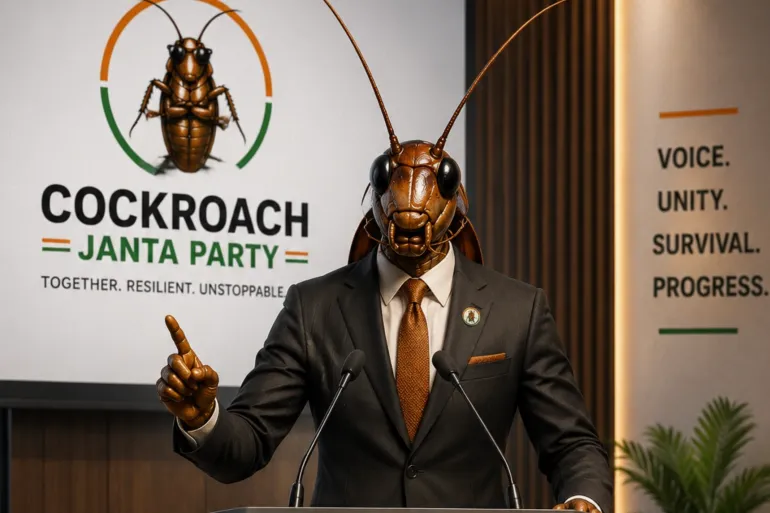
Amid the outrage, a 30-year-old public relations graduate named Abhijeet Dipke posted a sarcastic message on social media asking, “What if all cockroaches come together?” That joke soon transformed into a full-fledged satirical political movement called the “Cockroach Janta Party,” a parody inspired by India’s ruling Bharatiya Janata Party (BJP).
Dipke quickly launched social media accounts and a website for the movement using AI tools like ChatGPT and Claude to design its manifesto and branding. Within days, thousands of people had joined the online campaign, including activists, retired bureaucrats, and political figures.
The movement particularly resonated with young Indians frustrated by rising unemployment and limited opportunities. India produces millions of graduates every year, yet unemployment among educated youth remains alarmingly high. Many users online felt the Chief Justice’s comments reflected a larger disconnect between the political system and the struggles of ordinary youth.
The “Cockroach Janta Party” describes itself humorously as “a political front of the youth, by the youth, for the youth.” Its satirical manifesto mocks political corruption, media bias, unemployment, and the lack of accountability in Indian politics. The movement’s slogan has also gone viral among Gen Z users, who are using humour and memes as a form of protest.
Retired civil servant Ashish Joshi, one of the early supporters of the movement, said people in India have become increasingly afraid to speak openly in recent years. According to him, the satirical party feels like a “breath of fresh air” in a tense political atmosphere.
Prominent lawyer and activist Prashant Bhushan also criticized the Chief Justice’s remarks, saying they reflected prejudice against activists and young people. He argued that the viral response shows growing frustration among citizens who are demanding accountability from institutions and leaders.
The movement has also gained attention because of its unusual approach. Instead of traditional political protests, it uses satire, memes, humour, and internet culture to express public anger. Many young people see it as more relatable and honest than mainstream political parties.
What started as a joke is now being viewed as a symbol of youth frustration in modern India. The rapid rise of the “Cockroach Janta Party” highlights how social media can transform sarcasm into a powerful political statement. For many young Indians, the movement is not just about a controversial comment — it represents deeper concerns about unemployment, inequality, freedom of expression, and the future of the country.