
Security has been significantly increased around the Bhojshala complex in Madhya Pradesh’s Dhar district following a recent High Court verdict that declared the disputed site a Hindu temple. The ruling has reignited discussions surrounding one of the state’s most sensitive religious disputes and prompted authorities to take extensive precautions to maintain peace and order.
For years, the Bhojshala complex remained at the center of a long-standing disagreement between Hindu and Muslim groups. Under an arrangement implemented by the Archaeological Survey of India (ASI) in 2003, Hindus were permitted to perform prayers at the site on Tuesdays, while Muslims were allowed to offer namaz on Fridays. This arrangement continued for more than two decades as legal proceedings regarding the ownership and religious status of the complex moved through the courts.
The situation changed after the Indore Bench of the Madhya Pradesh High Court delivered a significant ruling on May 15. The court declared the Bhojshala complex to be a temple dedicated to Goddess Saraswati and allowed Hindu worship at the site. The judgment marked a major development in the decades-old dispute and immediately attracted national attention.
With the first Friday arriving after the court’s decision, local authorities intensified security measures amid concerns that some individuals or groups might attempt to offer Friday prayers at the complex despite the new legal position. Officials stressed that maintaining law and order remained their top priority and that any attempts to create unrest would be dealt with firmly.
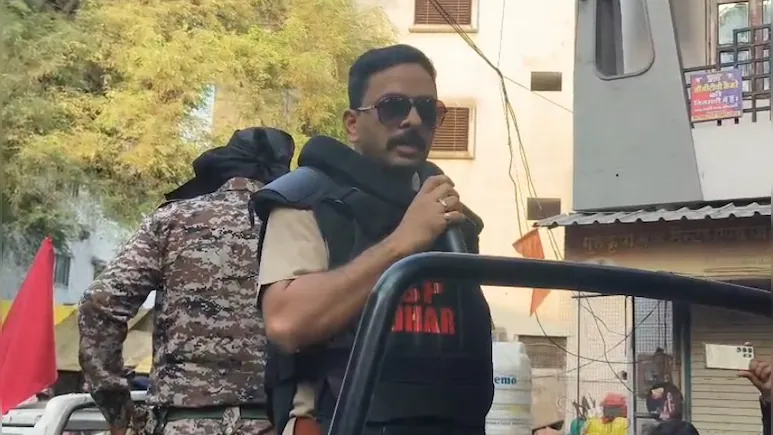
Adding to the public attention was a video featuring Dhar Superintendent of Police Sachin Sharma. The video quickly spread across social media platforms and attracted widespread discussion. In the footage, Sharma is seen addressing local residents while standing on a police vehicle. He delivers a strong message warning against any efforts to violate the law or disturb communal harmony.
The police officer emphasized that authorities were fully prepared to handle any situation that could threaten peace in the district. He warned that strict legal action would be taken against anyone attempting to challenge the law, spread misinformation, or create tensions around the Bhojshala issue. His speech also included an appeal to citizens to avoid sharing misleading interpretations of the court’s ruling on social media.
The video gained significant traction online, with many users praising the administration’s efforts to prevent unrest and ensure compliance with the law. Others viewed the statement as a demonstration of the government’s determination to maintain order during a sensitive period.
Meanwhile, the legal battle over Bhojshala is far from over. Representatives from the Muslim community have approached the Supreme Court challenging the High Court’s verdict. They argue that the disputed site has historical and religious significance for Muslims and are seeking legal relief against the decision.
The High Court, while ruling in favor of Hindu worship at the site, also suggested that members of the Muslim community could approach the state government for the allocation of separate land for the construction of a mosque elsewhere in the district.
As legal proceedings continue, authorities remain focused on preventing any disturbance that could affect communal harmony. Security personnel have been deployed in large numbers around the Bhojshala complex, and surveillance measures have been strengthened to monitor the situation closely.
The coming weeks are expected to be crucial as the matter moves through higher courts. Until then, officials are urging residents to respect the law, avoid rumors, and contribute to maintaining peace in the region.