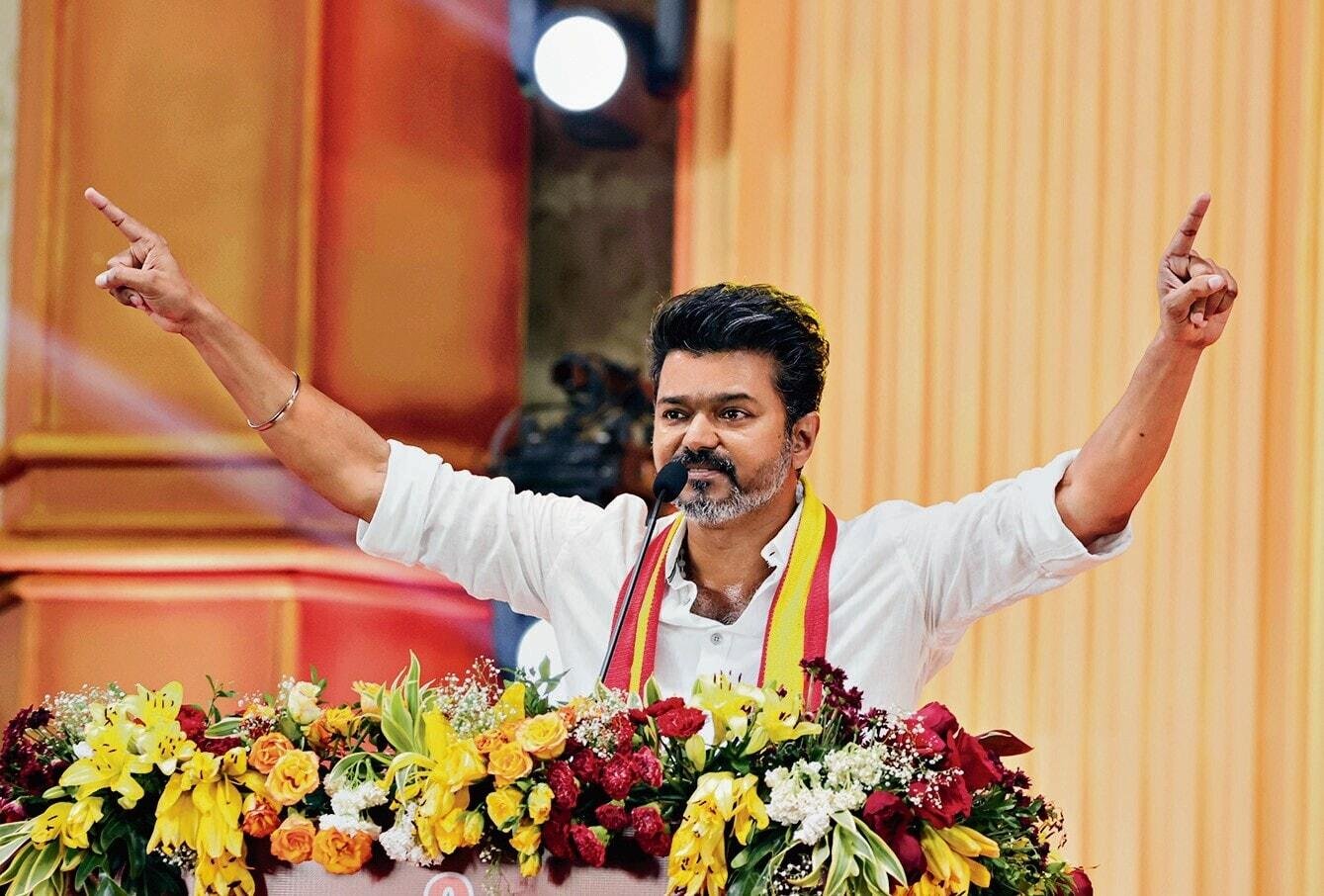
Vijay, a prominent political figure, celebrates a significant milestone or victory at a public event.
Actor-turned-politician Vijay created political history in Tamil Nadu after his party Tamilaga Vettri Kazhagam (TVK) emerged as the single largest party in its very first Assembly election. However, despite the impressive electoral performance, Vijay’s dream of becoming Chief Minister has reportedly hit a major hurdle due to what experts describe as a possible technical mistake during the government formation process.
Tamil Nadu witnessed a hung Assembly after the election results, with no party securing the required majority mark of 118 seats in the 234-member House. TVK won 108 seats, a remarkable achievement for a two-year-old political party. However, Vijay himself contested and won from two constituencies, meaning he would eventually have to vacate one seat. This effectively reduces TVK’s strength in the Assembly to 107 members.
The party later received support from the Congress, which managed to win five seats. With Congress backing, the combined strength of the TVK-led bloc increased to 112 seats. Even then, the alliance remained short of the majority mark by six seats.
According to political analysts, the real issue emerged when Vijay formally met Tamil Nadu Governor Rajendra Vishwanath Arlekar to stake claim to form the government. Reports suggest that the letter submitted by TVK included signatures not only from TVK MLAs but also from Congress legislators.
Constitutional experts say this may have complicated the situation. Under political convention, the Governor generally first invites the single largest party to form the government and later asks it to prove majority support on the floor of the House. However, by including Congress signatures in the claim letter, TVK may have unintentionally presented itself as a post-poll alliance rather than a single-party claimant.
This distinction has now become the center of legal and political debate. Some experts believe the Governor may use discretion in deciding whether to invite the single largest party or a coalition that appears more stable numerically.
Senior advocate Neeraj Kishan Kaul explained that the Indian Constitution does not provide a fixed formula for such situations. He referred to Article 163, which gives Governors certain discretionary powers in matters where the Constitution does not clearly define a procedure.
Kaul also referred to recommendations made by the Sarkaria Commission and Punchhi Commission regarding government formation in a hung Assembly. The Sarkaria Commission had suggested that preference should first be given to pre-poll alliances, followed by the single largest party, and then post-poll coalitions. Meanwhile, the Punchhi Commission proposed that the Governor could invite any party or alliance capable of commanding the broadest support in the Assembly.
However, other legal experts strongly disagree with the Governor’s hesitation. Former Attorney General Mukul Rohatgi argued that the Governor is constitutionally expected to first invite the single largest party when no rival alliance has formally staked claim. Congress MP and senior advocate Abhishek Manu Singhvi also supported this view, saying the Governor had very limited options in the current scenario.
The political situation in Tamil Nadu has now become extremely tense. Speculation is growing that rival parties like DMK and AIADMK may attempt unexpected political strategies to prevent TVK from forming the government.
Meanwhile, Vijay’s supporters believe the Governor’s delay is politically motivated and accuse the BJP-led Centre of influencing the process. Opposition parties have also raised concerns over constitutional fairness and democratic norms.For now, all eyes remain on Governor Rajendra Arlekar as Tamil Nadu waits to see whether Vijay will finally get the opportunity to prove his majority and become Chief Minister.