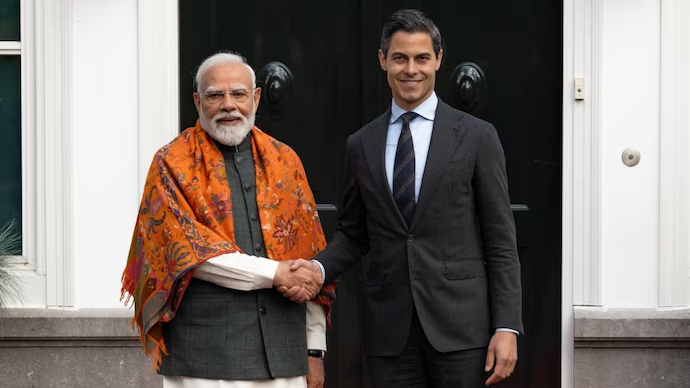
India and the Netherlands have decided to strengthen their bilateral relationship by upgrading it to a strategic partnership during Prime Minister Narendra Modi’s visit to The Hague. The announcement came after detailed discussions between Modi and Dutch Prime Minister Rob Jetten, with both leaders agreeing to expand cooperation across major sectors including semiconductors, clean energy, defence, healthcare, water management and advanced technology.
Modi’s visit to the Netherlands was part of his wider Europe tour aimed at strengthening India’s economic and strategic partnerships with key European nations. During the talks, both leaders reviewed the steady growth in India-Netherlands relations over the last decade and expressed confidence about future cooperation in innovation, sustainability and investment.
Prime Minister Modi described the Netherlands as one of India’s most trusted European partners and said the relationship was built on democratic values, strong economic cooperation and deep people-to-people ties. He highlighted that both countries share similar views on responsible governance, market-driven growth and global cooperation.
The leaders emphasized the importance of working together in future-focused industries such as semiconductor manufacturing, artificial intelligence, renewable energy and green hydrogen. Modi stated that Dutch technological expertise combined with India’s speed, skilled workforce and manufacturing capabilities could create major opportunities for both nations.
A major highlight of the visit was the CEO Roundtable held in The Hague, where top Dutch companies from sectors such as energy, agriculture, healthcare, ports and technology interacted with Indian officials. During the event, Modi invited Dutch companies to increase investments in India and participate in the country’s rapidly growing economy.
The Prime Minister stressed that India has become one of the world’s fastest-growing economies and has introduced major reforms to improve ease of doing business. According to Modi, reforms in taxation, labour laws and governance have made India an attractive destination for global investors and manufacturers.
He encouraged companies to “design, innovate and manufacture” in India, saying the country offers unmatched opportunities in digital technology, infrastructure, renewable energy and advanced manufacturing. Modi also noted that India’s large talent pool and cost-effective manufacturing ecosystem make it a preferred global investment destination.
Another significant development during the visit was the agreement between Tata Electronics and ASML to support India’s first front-end semiconductor fabrication facility in Dholera, Gujarat. The partnership is expected to play a key role in boosting India’s semiconductor ambitions and reducing dependence on imports in the technology sector.
Both countries also expressed support for the early conclusion of the India-European Union Free Trade Agreement, which is expected to improve trade and economic cooperation between India and European nations. The two leaders agreed that stronger collaboration in green hydrogen, clean energy, defence manufacturing and advanced technology would shape the future of India-Netherlands relations.
The visit marked an important step in strengthening India’s ties with Europe and showcased the growing global interest in India’s economic growth, manufacturing potential and technological capabilities.