Tamil Nadu Chief Minister C. Joseph Vijay has further expanded his cabinet by inducting representatives from key alliance partners, signaling a broader effort to strengthen the ruling coalition ahead of important political challenges in the state. The latest cabinet expansion reflects the government’s strategy of giving greater representation to allied parties while reinforcing administrative stability.
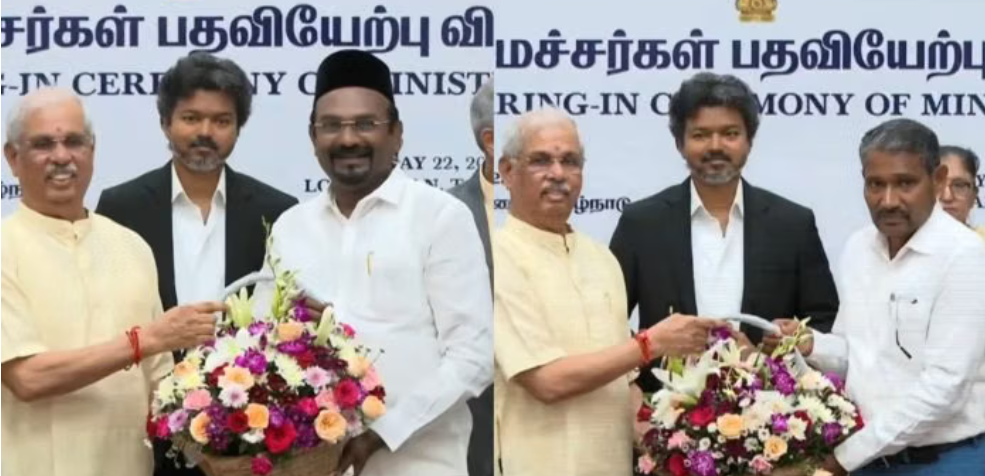
According to an official announcement from Tamil Nadu Lok Bhavan, two legislators are set to take oath as ministers in the state cabinet. The new entrants include AM Shahjahan of the Indian Union Muslim League (IUML), who represents the Papanasam Assembly constituency, and Vanni Arasu of the Viduthalai Chiruthaigal Katchi (VCK), the MLA from Tindivanam. Their swearing-in ceremony is scheduled to take place in Chennai, marking another phase of the government’s ongoing cabinet restructuring.
Political observers view the move as an attempt to strengthen ties with coalition partners and ensure broader participation in governance. Both IUML and VCK have played important roles in supporting the government, and their inclusion in the cabinet is expected to enhance coordination between alliance members.
The latest inductions come shortly after a major cabinet reshuffle carried out by Chief Minister Vijay. Several members of the Tamilaga Vettri Kazhagam (TVK) were assigned significant portfolios in the government. B. Rajkumar was entrusted with the Housing and Urban Development Department, while Vijay Tamilan Parthiban A took charge of the Transport Ministry. R.V. Ranjithkumar was assigned the Forest Department, V. Sampath Kumar became the Minister for Backward Classes Welfare, and V. Gandhiraj was given responsibility for the Co-operation Department.
The cabinet expansion is part of a broader effort to establish a balanced administration capable of addressing the state’s developmental priorities. Following the formation of the new government, a total of 23 ministers were allocated portfolios covering key sectors such as finance, welfare, transport, revenue, urban development, and technology.
One of the most notable developments in the new administration is the creation of a dedicated Artificial Intelligence (AI) department at the cabinet level. With this decision, Tamil Nadu has become only the second state in India after Kerala to establish a separate ministry focused on AI and emerging technologies. The initiative highlights the government’s emphasis on innovation, digital governance, and technology-driven growth.
Chief Minister Vijay has retained control over several crucial departments, including Home, Police, Municipal Administration, Urban Development, and Water Supply. In addition, he continues to oversee Special Initiatives, Poverty Alleviation, and Rural Indebtedness. These portfolios are considered central to the government’s policy agenda and long-term development plans.
Another significant change involves the Women Welfare portfolio. Previously managed directly through the Chief Minister’s office, the department has now been assigned to K. Jegadeshwari, who serves as the Minister for Social Welfare and Women Empowerment. The move is expected to provide greater focus on issues related to women’s welfare, social justice, and community development.
Senior leader K.A. Sengottaiyan has been entrusted with the Revenue Department and will oversee disaster management, district revenue administration, legislative matters, and land-related issues. Meanwhile, N. Marie Wilson has been appointed Finance Minister and will handle state finances, pensions, planning, and development initiatives.
The cabinet also includes representation from the Congress party, with MLAs S. Rajesh Kumar and P. Viswanathan taking oath as ministers. Their inclusion further reflects the coalition government’s commitment to accommodating alliance partners.
With the latest cabinet expansion, the Vijay-led administration aims to strengthen governance, improve coordination among coalition members, and prepare for future political and administrative challenges while advancing its development-focused agenda.